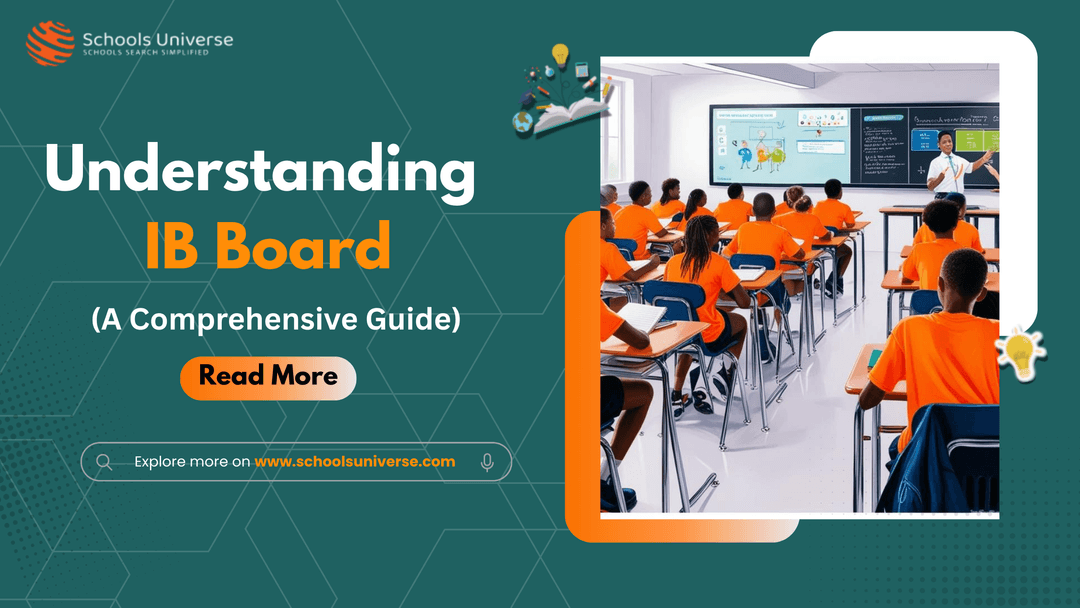
The International Baccalaureate (IB) board is a very popular board in India and also worldwide for its holistic, globally recognized curriculum. If you’re searching for the best International Curriculum, understanding about the IB board and IB syllabus is important, and knowing the difference of IB from CBSE and ICSE is crucial for choosing the right Board for your child. In this blog, you will learn about the IB curriculum. This blog contains all the key features, structure and its syllabus so that you can compare it with other boards then make the final decision.
What is the IB Board? | International Baccalaureate Board Overview
International Baccalaureate (IB) Board which was established in 1968 and headquartered in Geneva, is a nonprofit educational foundation that is offering a globally standardized curriculum for students. The IB board is recognized for its focus on individuals with strong academic, social, and emotional skills, preparing students for their success in a rapidly changing world.
Key Features of the IB Board
-
Global recognition and acceptance by top universities
-
Emphasis on critical thinking, inquiry, and research skills
-
Focus on holistic development like academic, creative, and social
-
Flexibility in subject choices for students
-
Very Strong alignment to international education standards
📚 IB Curriculum Structure
The IB board offers four educational programmes catering to different age groups:
|
Programme Name |
Age Group |
Key Focus |
|
Primary Years Programme (PYP) |
3 to 12 |
Inquiry based learning and foundational skills |
|
Middle Years Programme (MYP) |
11 to 16 |
Interdisciplinary learning, global context |
|
Diploma Programme (DP) |
16 to 19 |
Academic depth, research, Early university prep |
|
Career-related Programme (CP) |
16 to 19 |
Full career focused with practical skills |
What is PYP
PYP stands for Primary Years Programme, a curriculum framework offered by the International Baccalaureate (IB) for students aged 3 to 12. It's designed in such a way that students love to encourage students to explore their world through questioning, research, and investigation
What is MYP
The International Baccalaureate (IB) Middle Years Programme (MYP) is a five year program for students who are aged 11 to 16 years old. The MYP focuses on developing essential skills like critical thinking, communication, and collaboration.
Detailed International Baccalaureate Syllabus | IB Syllabus Guide 2025-26
The IB syllabus flexibility and comprehensive approach makes it the best Curriculum. Students can tailor their learning journey with choosing the subjects based on their interests and future goals.
IB Subjects
Students in the IB Diploma Programme (IBDP) select one subject from each of the six groups:
-
Language and Literature (English)
-
Language Acquisition (Foreign Languages)
-
Individuals and Societies (Economics, History, Geography)
-
Experimental Sciences (Physics, Chemistry, Biology)
-
Mathematics
-
The Arts (Music, Theatre, Visual Arts)1
Core Components of the IB Syllabus
The IB Diploma Programme includes three core elements that foster holistic development:
-
Theory of Knowledge (TOK): Encourages students as it reflects on the nature of knowledge and is evaluated across disciplines.
-
Extended Essay (EE): A 4,000-word independent research project, preparing students for university-level work.
-
Creativity, Activity, Service (CAS): Involves participation in artistic, physical, and service activities, promoting well-rounded growth.
Assessment in IB
-
Internal Assessments: Research essays, written tasks, oral presentations, and project work, evaluated by teachers.
-
External Assessments: Final exams and essays, graded by external IB examiners
IB Grading System | IB Board Grading Explained
The IB grading system is unique and comprehensive, evaluating students on both academic and non-academic achievements
|
Assessment Type |
Description |
|
Internal Assessment |
Ongoing assignments, essays, projects, classwork |
|
External Assessment |
Final year exams, externally evaluated |
-
Each subject is graded on a scale of 1 to 7 (7 being the highest).
-
The three core components (TOK, EE, CAS) collectively contribute up to 3 bonus points.
-
The maximum possible score is 45 (6 subjects x 7 = 42 + 3 core points).
-
A minimum of 24 points is required to earn the IB Diploma
IB Board vs CBSE vs ICSE | IB Board Comparison Table
Choosing the right curriculum often comes down to comparing the IB board with CBSE and ICSE. Here’s a quick comparison:
|
Feature |
IB Board |
CBSE |
ICSE |
|
Recognition |
Global |
National (India) |
National (India) |
|
Curriculum Focus |
Holistic, inquiry-based, flexible |
Rote learning, exam-centric |
Subject-focused, balanced |
|
Subject Choices |
Wide, flexible |
Limited, predefined |
Moderate, grouped |
|
Assessment |
Internal & External, project-based |
Internal & External, exam-heavy |
Internal & External, practicals |
|
University Prep |
Strong international focus |
Good for Indian entrance exams |
Good for Indian universities |
|
Extra-curricular |
Mandatory (CAS) |
Optional |
Optional |
|
Grading System |
1–7 per subject, 45 max |
Percentage-based |
Percentage-based |
IB Board vs IGCSE | Which International Board is Better?
Both IB and IGCSE are international boards, but they differ in structure and approach:
|
Feature |
IB Board |
IGCSE |
|
Curriculum |
Skill-centered, flexible, no fixed textbooks |
Structured, prescribed textbooks |
|
Assessment |
Internal & External, project-based |
Exam-centric, Cambridge exams |
|
Focus |
Balance of academics and extra-curricular |
Academic knowledge |
|
University Prep |
Excellent for global university admissions |
Good, but less holistic |
🏫 Top IB Schools in India
If you're considering the IB board for your child, here are some of the top IB schools in India:
|
School Name |
Location |
Notable Features |
|
The International School Bangalore (TISB) |
Bangalore |
Academic excellence, MUN events, diverse activities |
|
Dhirubhai Ambani International School (DAIS) |
Mumbai |
High academic standards, global university placements |
|
The British School |
New Delhi |
Diverse student body, strong extracurricular programs |
|
Oakridge International School |
Hyderabad |
Modern facilities, experienced faculty |
Advantages of IB Board
-
Globally recognized and accepted by top universities.
-
Develops critical thinking, research, and communication skills through IB middle years program for students.
-
Encourages creativity, physical activity, and community service.
-
Flexible subject choices to match student interests and career goals.
-
Prepares students for success in a globalized world.
Frequently Asked Questions about IB Board
1.What is the fees of IB board in India?
IB school fees in India can range approximately ₹3.5 to ₹12 lakh per year, depending on the factors of schools like program you choose, location and other factors. Mainly Metropolitan areas like Delhi, Mumbai, Bangalore, and Hyderabad tend to have higher fees than others, as you already know that schools in smaller cities or suburban areas may be slightly less expensive.
2. What are the IB subjects?
Students choose subjects from the following subject groups: studies in language and literature, language acquisition, individuals and societies, sciences, mathematics and the arts
3. Is the IB board recognized in India?
Yes, the IB board is recognized by many Indian institutions and international universities. There are currently 223 IB World Schools in India that offer one or more of the IB programs
4. Can students switch to the IB Board after studying in CBSE or ICSE?
Yes, students can join the IB Diploma Programme after completing grade 10 in CBSE, ICSE, or other state boards. The IB curriculum is designed to accommodate students transitioning from various educational systems.
5. Is IB better than CBSE?
There's no single answer to whether IB is "better" than CBSE, as both curriculums have their own strengths and are suitable for different students and goals. IB is known for its global recognition and focus on interdisciplinary, practical learning, while CBSE offers a more traditional, nationally-focused approach with a strong emphasis on academics.
The International Baccalaureate (IB) board is a leading choice for parents and students seeking the best education which is also flexible for students. With its internationally recognized curriculum that focuses on all-round development, and strong university preparation at the age of 16, the IB board stands out as the best international school curriculum in India and beyond.
Whether you’re looking for the Best IB schools, want to understand the complete IB syllabus, or are comparing IB vs CBSE and ICSE, this guide covers everything you need to make an informed decision for your child’s future.
Best Schools
- Best Schools in Hyderabad
- Best Schools in Bangalore
- Best Schools in Chennai
- Best Schools in Gurgaon
- Best Schools in Pune
- Best Schools in Kolkata
- Best Schools in Mumbai
- Best Schools in Jaipur
- Best Schools in Indore
- Best Schools in Thane
- Best Schools in Bhopal
- Best Schools in Nagpur
- Best Schools in Aurangabad
- Best Schools in Jodhpur
- Best Schools in Jabalpur
- Best Schools in Noida
- Best Schools in Delhi
CBSE Schools
- CBSE Schools in Kolkata
- CBSE Schools in Chennai
- CBSE Schools in Hyderabad
- CBSE Schools in Bangalore
- CBSE Schools in Pune
- CBSE Schools in Mumbai
- CBSE Schools in Jaipur
- CBSE Schools in Nagpur
- CBSE Schools in Thane
- CBSE Schools in Aurangabad
- CBSE Schools in Jodhpur
- CBSE Schools in Indore
- CBSE Schools in Jabalpur
- CBSE Schools in Bhopal
- CBSE Schools in Gurgaon
- CBSE Schools in Noida
- CBSE Schools in Delhi

Get In Touch
Your questions deserve expert answers Let's Talk